







Katie Okamoto
For years, I aspired to be a light packer. The task of assembling a minimalist, space-efficient packing system was like catnip to my architecture training and my spread-sheeting tendencies.
I loved the idea of striding through airports and wandering cobblestone streets unbothered and unencumbered. I also admit that, subconsciously, I viewed packing light as being superior — and this was before I learned that an airplane’s cargo weight is a factor in a flight’s carbon emissions.
You might think these predilections would make me a spokesperson for the one baggers. Instead, I burrowed deeper into an opposing side of my personality: the over-preparer. I’m an anxious and allergic traveller.
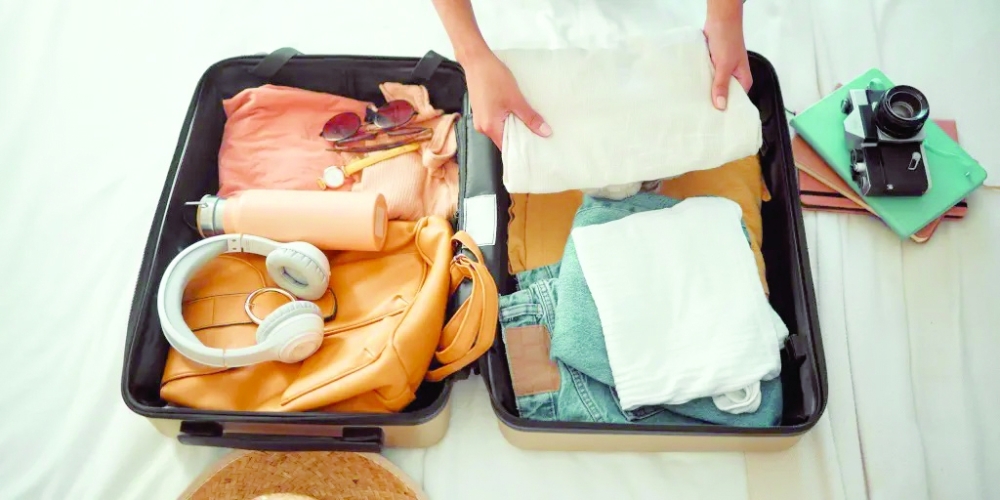
Instead of allowing me to pack less, my preferred wardrobe of lightweight, black clothes and my solid shampoo bars have made room for snacks, books I won’t read and occasionally a spare cutting board. I often strain to lift my carry-on bag into the overhead bin.
We all possess polarities that we must mediate between. But recently, as I prepared for a work trip from Los Angeles to New York City, I wondered if I was letting myself off the hook too easily.
Through years of reporting on sustainability, I know that air travel is the single biggest source of carbon emissions for most Americans. That means one of the most significant ways you can reduce your personal environmental impact is to simply avoid unnecessary flying.
The US produces some of the highest per-capita emissions from domestic flights in the world, according to Our World in Data, so our choices can have a real impact.
However, “the reality is that some air travel is necessary, meaningful and even life-affirming”, said Renée Lertzman, a climate psychologist, consultant and author of the Becoming Guides newsletter. Rather than shaming ourselves over flying, our goal should be to “think more critically about when and why we fly; and to channel our concern into advocacy and support for systemic change”, Lertzman explained.
Back to my packing list. From a purely mathematical perspective, yes, shaving down an airplane’s weight — by not checking a bag, for example — can help reduce your individual impact, though not by much.
“Not a huge amount, in the bigger scheme of things, but it helps”, Jonathan Foley, an environmental scientist and executive director of Project Drawdown, said in an email.
As for exactly how much your impact is reduced, that depends on where you’re going and how much packing weight you’re cutting. In one study, published in 2025 in Nature, the authors estimate that for a flight from Singapore to Zurich, an economy passenger who packed only a carry-on could avoid emitting around 625 kg of carbon dioxide equivalents; that’s roughly equal to the amount emitted from burning 70 gallons of gasoline, according to the EPA’s greenhouse gas calculator.
But you’re still flying, so it might be misleading to equate packing lighter with avoiding emissions altogether, said Kimberly Nicholas, sustainability professor at the Lund University Centre for Sustainability Studies and the author of the newsletter We Can Fix It and the SHIFT guide to taking climate action, in partnership with Project Drawdown. Also, stressing over the weight of your luggage could amount to what Lertzman described as “environmental busywork”, an anxiety-fuelled distraction from taking more-substantial action.
There is also the chance that fixating on a suitcase’s weight might lead you to think of yourself as a sustainable traveller. This is something that Lorraine Whitmarsh, an environmental psychologist and director of the Centre for Climate Change and Social Transformations at the University of Bath, terms ‘moral licensing’, the belief that by making a marginally lower-impact choice, one can then make that choice more often.
That doesn’t mean you won’t make any difference by not checking a bag. A “desire to align one’s actions with one’s values” is meaningful, said Lertzman and it can spur us to greater change.
When you’re getting on an airplane, the biggest impact you can make starts with your ticket. First of all, fly economy. “This makes the biggest difference in reducing your flight emissions”, Nicholas said.
Two recent studies have found that when you’re flying first or business class, your carbon footprint can be anywhere from two to five times more carbon-intensive than if you were flying economy. That’s because higher-tier cabins make less-efficient use of an airplane’s floorplan.
Booking a direct flight can also lower your trip’s emissions, since the most fuel is used during takeoff, said Foley: “It’s estimated that somewhere between 25-50 per cent of the emissions can be saved this way”.
When I board my next flight to New York, I’ll probably stuff those extra books and snacks in my carry-on and I won’t judge my fellow travellers for having bags that are bursting at the seams. — The New York Times
Oman Observer is now on the WhatsApp channel. Click here


